By Aurora Priego and Emma Ronne
Editor’s note: Names were changed for the identities of the survivors.
Jazlyn Flores volunteers as a domestic violence advocate at Mujeres Latinas en Acción, an organization that works with victims of domestic violence and sexual assault. The agency offers various services ranging from therapy, crisis intervention, family engagement, to domestic violence training.
“My definition of domestic violence before I was an advocate was basically physical abuse,” said Flores. Since working at Mujeres Latinas en Acción, she has come to realize that Domestic Violence can take many shapes.
According to The National Domestic Violence Hotline and expert sources, Domestic Violence is defined by the use of certain behaviors by an intimate partner to exercise power and control over another. Abuse goes beyond physical and sexual violence and can include coercion, intimidation, emotional, and economic abuse.
And it is a worldwide issue. The Illinois Coalition Against Domestic Violence reports that 1 in 3 women and 1 in 7 men are victims of domestic violence around the globe. According to the National Coalition Against Domestic Violence, 37.7% of women and 25.7% of men in Illinois experience a form of intimate partner violence or stalking.
From prior to 2006, to 2018, and beyond, the amount of individuals impacted by domestic violence has remained shockingly high.
“I would say over the years many more people are reporting domestic violence occurrences, so definitely cases have been increasing but we cannot say domestic violence is getting worse over time because in the past it has been severely underreported,” said Flores.
In Chicago, individuals are battling domestic violence daily. A study by Loyola University’s David Olsen and Sema Taheri reveals that domestic battery charges made up 12.7% of all admissions to Cook County Jail in 2011 and that domestic battery charges accounted for 44.3% of admissions related to violent charges.
However, these numbers fail to capture the entire problem, since instances of domestic violence often go unreported. There are a host of reasons why victims may choose not to report, including fear, situational and emotional factors, and the stigma attached to the concept of domestic violence.
Chicagoan Miranda has firsthand experience with domestic violence and how complicated it can be to seek help. She recalled having a difficult time recognizing her situation as abusive. She kept private about the abuse inflicted by the father of her child.
“I never really talked to anybody when it was happening,” she said. “I never told anybody that he hit me.”
Miranda said she struggled with opening up about her situation for fear of revealing that the father of her child was undocumented and because she still loved him. According to the National Center for Health Research, survivors of domestic violence like Miranda can become entrapped in a cycle of abuse that is difficult to escape.
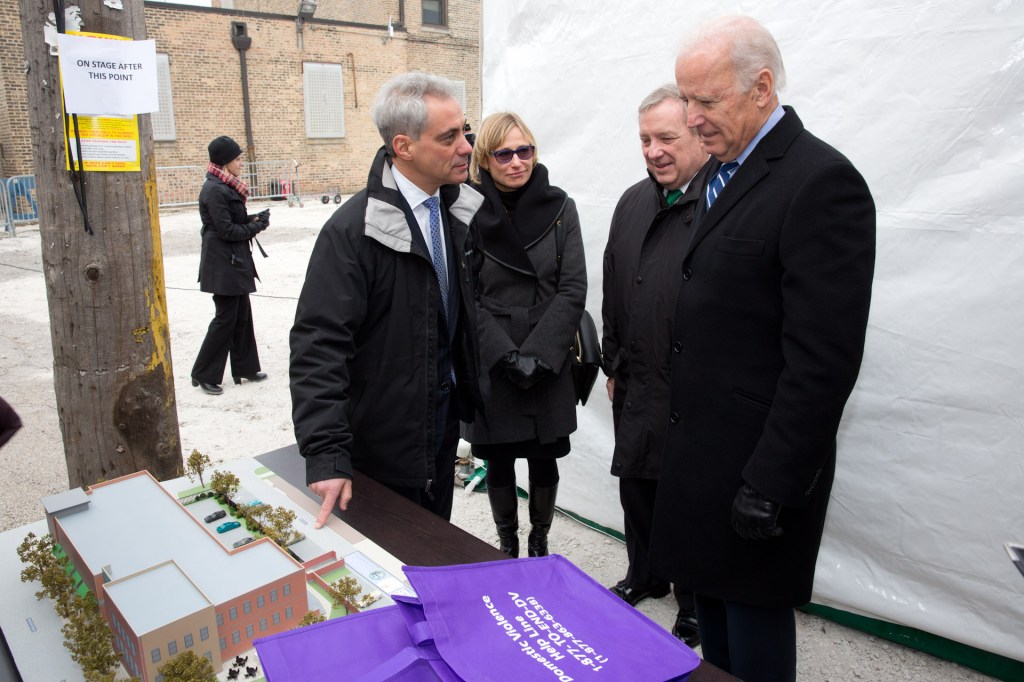
Photo by Lawrence Jackson
There are many resources and organizations available throughout Chicago that aid survivors like Miranda on their road to recovery and stability. The City of Chicago Domestic Violence Help Line, operated by the Chicago Metropolitan Battered Women’s Network, directs victims to the support they need. The Help Line can counsel victims over the phone and refer them to providers in their community.
StoryMap: Domestic Violence Agencies in Chicago
A violentometro is a popular mechanism that is used by many organizations to help victims identify whether they are in a domestic violence situation. The violentometro is a scale that lists different forms of abusive behavior and ranks the severity of the action from being cautious to alerting individuals they need professional help.
Between Friends, located on the city’s North Side, is a nonprofit agency that raises money for domestic violence programs in Chicago and offers a crisis line, crisis intervention, counseling, and court advocacy, as well as prevention and education outreach initiatives — all free of charge.
Shelter is a crucial part of caring for survivors of domestic violence. Victims might feel trapped in a home with their abuser and need a safe environment. Miranda and Sara were caught in a home situation that felt dangerous. “When things got out of hand obviously I wasn’t feeling safe there,” she said.
Some of the most common resources domestic violence victims are provided with are crisis hotlines, shelters, and services for their children if the victims have children. But even then there are still a lot of needs that victims aren’t met with when searching for help.
Flores described some of the reasons that domestic violence goes unreported. She noted that “A lot of these people are scared. For their life, for their kids, and it’s something that we shouldn’t take lightly.”
“Sometimes the clients themselves have downplayed their abuse,” Flores also pointed out.
Miranda experienced the minimizing that Flores recognized, and after keeping her abuse to herself for a while, Miranda reached a breaking point.
“Once my baby was three months I just realized that this was not OK,” she said. “My baby should not have to grow up around this type of environment.”
While many resources exist in Chicago to help survivors, some individuals do not get the help they desperately need. When Miranda sought counseling through her university she was placed on a waitlist.
Flores said there’s “not enough resources for everyone” and recounted the experience of working with victims who could not find shelter space since shelters are often full.

Photo by Wikimedia Commons
“A lot of these victims don’t have anywhere else to go,” Flores said. “Sometimes they have to stay with the abuser or live on the streets.”
In other instances, victims who leave may only have a few places to resort to, so they file an order of protection against the abuser. However, that may not stop the abuser from staying away, as experienced by Sara, who told her story in Spanish and is translated:
“It didn’t matter what I did, he always found me,” she said. “I managed to escape multiple times but he always threatened me with the lives of my mom and family, so I always came back to him as a result of fear. I was in a lot of fear because I knew he was capable of keeping his promises.”
What can be done to help those facing domestic violence? Flores highlighted the need for more education on the subject and urged people to volunteer, donate, educate yourself, and simply be kind to one another.
“Maybe someone you know closely is going through domestic violence,” she said, “but you can’t see it because it’s very hard to tell.”
When asked what message she had for other survivors of domestic violence, Miranda made one point clear.
“Never ever think that it’s OK,” she said.
 Aurora Priego Digital Journalism